
Nội dung chính
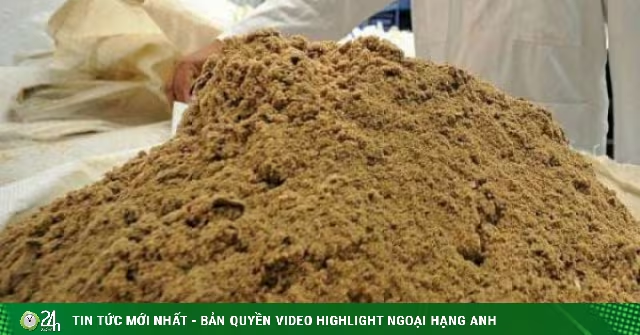
Vietnam’s fishmeal export surged to around $300 million in 2025, underscoring a huge untapped potential.
At the 2025 Fisheries and Aquaculture Department’s year‑end conference, Nguyễn Hoài Nam, Secretary‑General of the Vietnam Association of Seafood Processing and Export (VASEP), announced that Vietnam’s fishmeal export value reached approximately USD 300 million. This amount covers only the overseas market; domestic usage is additional.
Global demand: China dominates
Worldwide, the appetite for fishmeal continues to rise. Peru remains the largest producer, contributing about 20 % of global output, mainly from anchovy. However, China is by far the biggest importer, accounting for roughly 90 % of all imported fishmeal.
Vietnam’s production backbone
According to the Fisheries and Aquaculture Department, total marine production in 2025 hit 9.95 million tons, a 3 % increase over 2024. Of this, aquaculture accounted for 6.1 million tons (+5.1 %), while wild capture contributed 3.83 million tons.
Correspondingly, the domestic feed industry produced 5.39 million tons of aquafeed in 2025 (1.4 Mt for shrimp, 2.02 Mt for pangasius, 1.97 Mt for other species).
Why fishmeal matters
Fishmeal is a high‑protein, amino‑acid‑rich ingredient used primarily in feed for livestock, poultry, aquaculture and even pets. Its nutritional profile also makes it a valuable organic fertilizer that boosts soil fertility and crop yields.
Vietnam’s dual role: producer and importer
Despite being a net producer, Vietnam imported 114,619 tons of fishmeal in 2022, ranking seventh globally. The import volume is climbing as demand for shrimp and fish feed intensifies.
Success stories from the field
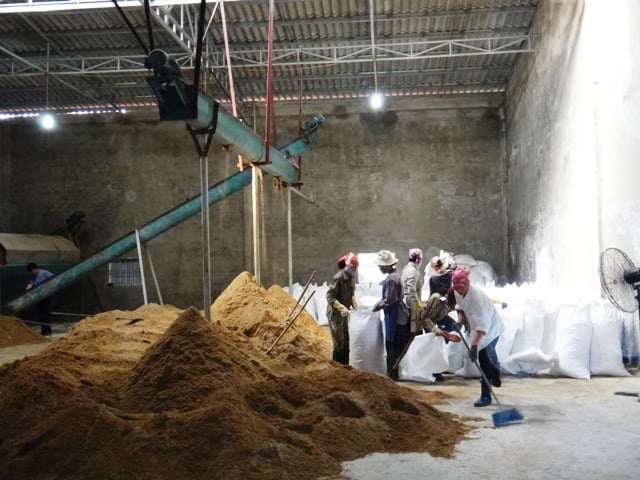
In Ho Chi Minh City, Phúc Lộc Co., Ltd. purchases about 60 tons of fish waste daily from fishing vessels and processing plants, converting it into 4,000–5,000 tons of fishmeal per year. The operation generates revenue of VND 72–90 billion and, with additional capital and technology, could raise protein content to 64 % and cut national fishmeal imports by 140,000 tons annually.
Tứ Hải Co., Ltd., located in Phước Thắng, transforms fish bones that once sold for a few thousand VND/kg into dried products exported to Japan at US$10 per kg, yielding VND 10–12 billion per year. The Southern Institute of Marine Research also exploits crab shells for canned crab soup and extracts chitosan—a high‑value biomedical and agricultural polymer—selling up to US$1,000 per kg.

Future outlook and policy needs
Projections indicate that by 2030, waste from shrimp processing could yield 650,000 tons of by‑products valued at $80–100 million, while catfish waste could generate over 1.3 million tons worth more than $500 million.
Experts such as Prof. Phạm Quốc Huy of the Southern Marine Research Institute stress that turning waste into a resource requires a dedicated industry framework, supportive tax and green‑credit policies, and clear classification under the fisheries sector rather than livestock. Aligning enterprises, scientists, artisans and regulators will convert what is now “trash” into “green gold”, driving a circular marine economy and elevating Vietnam’s position on the global seafood map.